
Beyond the Liquid Horizon: Why Solid-State Batteries Are the Hardware Shift to Watch

There is a distinct satisfaction in hardware engineered to last—the kind of tactile, un-killable mechanics where every relay, chassis, and wire run feels deliberately overbuilt to handle real-world abuse. Modern battery tech, for all its revolutionary impact, has never quite shared that DNA. Our current reliance on liquid-electrolyte lithium-ion cells has always felt like a necessary compromise: we get high energy density, but at the cost of volatile chemistry, delicate thermal management, and the looming specter of thermal runaway.
We have pushed traditional lithium-ion chemistry remarkably close to its thermodynamic ceiling. To take the next real leap in performance and reliability, the physical architecture has to change. That is where solid-state batteries (SSBs) enter the frame.
The Architecture: Swapping Volatile Liquid for Solid Structure
Traditional lithium-ion batteries rely on a liquid or gel electrolyte to transport ions between the cathode and anode, separated by a porous plastic membrane. When pushed hard—whether through ultra-fast charging, mechanical impact, or internal short circuits—those liquid organic solvents become flammable fuel.
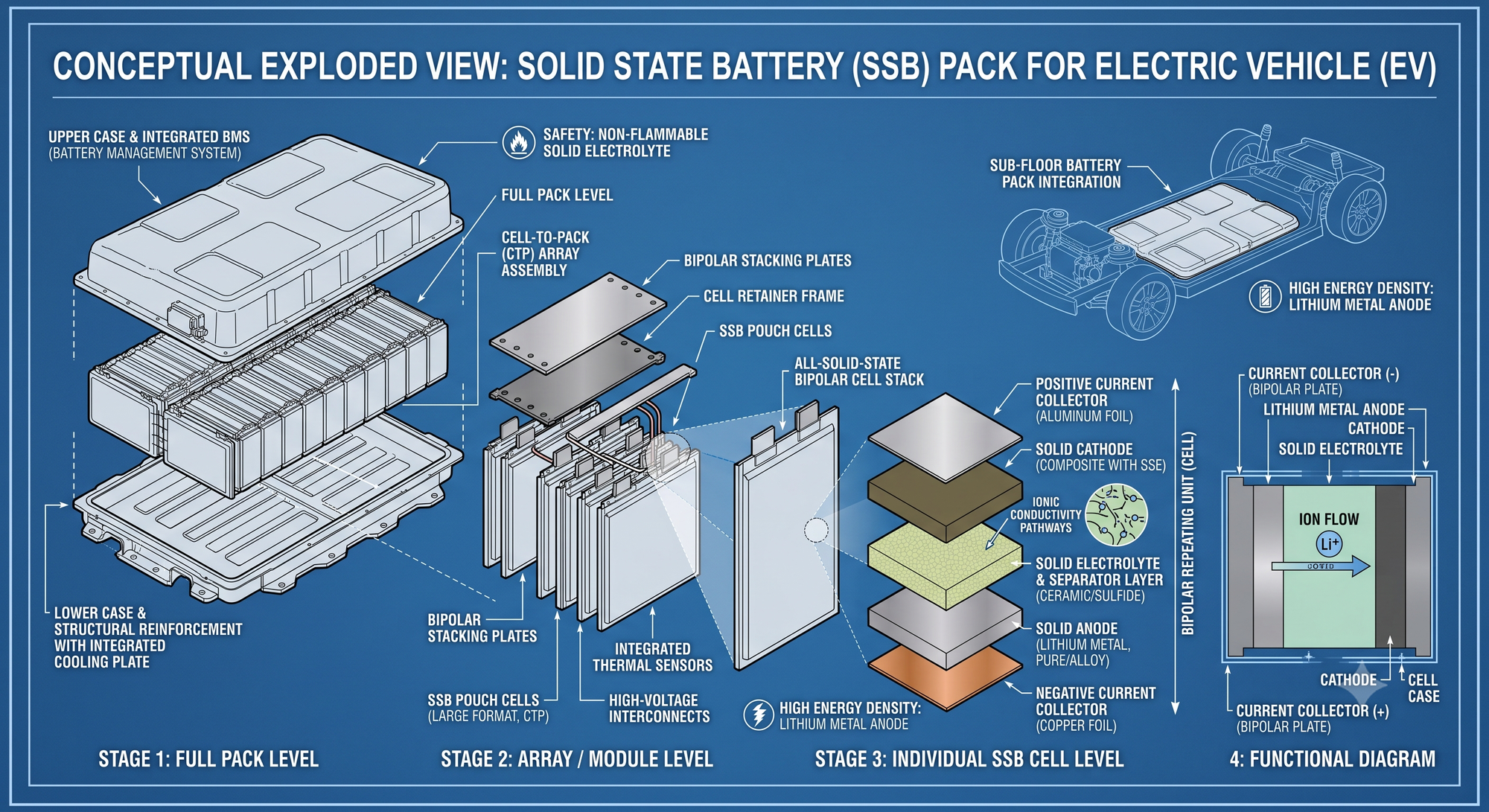
Solid-state technology replaces that entire fluid subsystem with a solid ionic conductor (typically advanced ceramics, sulfides, or polymers).
- Eliminating the Fire Hazard: Without flammable solvents, thermal runaway risk drops precipitously. Cells can tolerate significantly higher operating temperatures without decomposing or bursting into flames.
- Unlocking Lithium-Metal Anodes: Solid electrolytes provide a physical barrier that resists dendrite formation (microscopic lithium spikes that cause internal shorts). This allows the use of pure lithium-metal anodes instead of heavier graphite, drastically boosting volumetric energy density.
- Simpler System Packaging: Less volatile chemistry means battery packs require fewer heavy liquid-cooling loops, passive heat sinks, and armored enclosures, translating directly to lighter, more space-efficient installations.
What Will They Actually Look Like?
From the outside, solid-state cells won’t look like science fiction props. Initially, they will arrive in familiar form factors: ultra-dense pouch cells, rigid prismatic blocks, and high-spec cylindrical formats.
Because solid electrolyte layers can be manufactured exceptionally thin and don't require rigid pressure vessels to contain fluid vapor, the real physical shift will happen at the system level. Expect ultra-flat, rigid battery arrays that integrate directly into the structural load-bearing frames of vehicles, off-grid power banks, and portable electronics—functioning as structural members rather than isolated dead weight in an armored enclosure.
The Reality Check: When Do They Actually Arrive?
The physics of solid-state storage is proven; the current hurdle is manufacturing scaling. Producing brittle ceramic separators or moisture-sensitive sulfide layers at sub-micron tolerances, across millions of units without microscopic defects, is a monumental manufacturing challenge.
The transition will not happen overnight, but the roadmap is crystallizing into distinct phases:
- 2024–2026 (Specialized & Semi-Solid Deployments): "Semi-solid" or hybrid cells (using a solid matrix with trace liquid electrolyte) have already begun rolling out in niche, high-end EV packs and specialized industrial gear. True all-solid-state cells remain in low-volume pilot runs, qualification testing, and niche aerospace/defense contracts.
- 2027–2028 (Premium Commercial Adoption): Major automotive manufacturers are targeting low-volume production lines. Expect these early solid-state packs to debut first in premium flagship EVs, high-performance marine setups, and specialized commercial platforms where cost-per-kWh is secondary to raw energy density and uncompromised safety.
- 2030 and Beyond (Mass-Market Parity): As gigafactory tooling matures and material supply chains scale, production costs will decline toward parity with conventional lithium iron phosphate (LFP) and NMC cells. This is the window where solid-state technology becomes a standard drop-in choice for mainstream consumer devices, standard vehicles, and everyday hardware projects.
Final Thoughts
Hardware breakthroughs that fundamentally alter safety and energy density don’t come around often. Much like the transition from mechanical relays to silicon, moving away from volatile liquid electrolytes toward solid, resilient architectures will redefine what we can build and how hard we can run it. It’s a hardware revolution happening at the microscopic level—and one well worth tracking.